
How Much Does Custom App Development Cost in 2026? A Realistic Breakdown
Building a custom application may be cost effective if the brief specifies "login, dashboard, and payments," but the reality of the implementation makes any quote deceptive.
Once the process starts, the development team will identify the permissions, third-party connections, security standards, QA procedures, and support options required for the software to function properly and keep all stakeholders satisfied. Knowing what determines the cost of custom apps is essential for allocating the budget efficiently.
According to GoodFirms’ custom application development pricing research , the global custom application development market size was estimated at USD 6.9 billion in 2022 and is expected to reach a value of USD 11.7 billion by 2026. Reports suggest that custom app development costs range between USD 15,000 – 40,000 for a basic mobile application and up to USD 250,000+ for enterprise level software in 2026, on average. This data reflects a mid market price guideline for organizations that want to build their own application with custom features, user base, and technical support.
For companies that want to develop a custom application, MatchBest Group offers web and mobile development services and broader enterprise technology solutions.
Quick Answer
Custom application development costs in 2026 are determined by the software complexity, required integrations, security standards, and support options. According to the estimates provided in this article, a simple mobile app may cost $15,000 – $40,000, a medium-level application – $40,000 – $120,000, while an advanced or enterprise level application may cost $100,000 – $500,000+ (or even more). These are just approximate figures, and there is no final cost for a custom application. To reduce the costs of software development, it is critical to plan the MVP and prioritize features, request multiple proposals (based on the same requirements), and consider additional costs (hosting, maintenance, testing, and third party services). MatchBest Group can assist in web and mobile development to help you design a custom software project according to your requirements.
How Much Does a Custom App Cost in 2026?
GoodFirms' 2026 survey of 267 mobile app development companies gives a practical starting point:
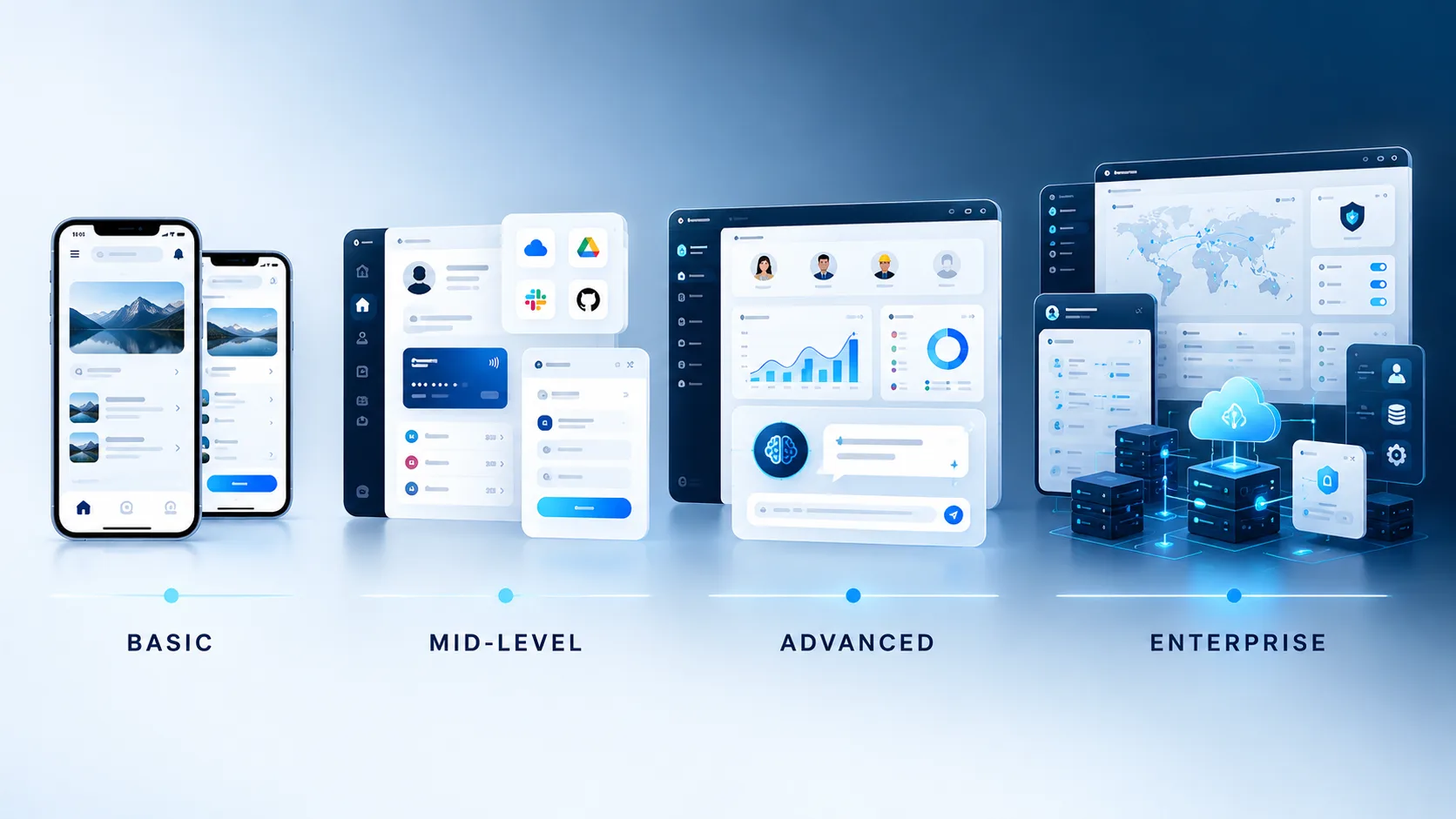
| App Complexity | Estimated Cost (USD) | Typical Requirements |
|---|---|---|
| Basic app | $15,000–$40,000 | Simple login, profiles, content, and navigation |
| Mid-level app | $40,000–$120,000 | Payments, custom interfaces, and third-party integrations |
| Advanced app | $100,000–$250,000+ | Real-time features, multiple user roles, and AI capabilities |
| Enterprise app | $250,000–$500,000+ | Complex integrations, high scalability, and security requirements |
What Makes One App Significantly More Expensive Than Another?
A booking app that only displays available appointments is different from one that accepts payments, reschedules appointments, syncs calendars, and sends reminders.
Three areas deserve particular attention:
● Integrations: Connecting payment providers, customer databases, or legacy systems requires development, authentication, error handling, and testing.
● Design and user roles: Separate experiences for customers, administrators, and partners create additional workflows and permissions.
● Security and reliability: Sensitive data, audit trails, heavy traffic, and availability requirements demand more engineering and validation.
AI features may add model integration, data preparation, monitoring, and quality checks. Include them only where useful.
Where Does the Development Budget Actually Go?
A realistic proposal should break down the job into phases rather than one undefined sum
- Discovery makes clear the user journeys, priorities, technical constraints, and acceptance criteria
- Design creates the screens and interactions based on those requirements Development builds the interface, database, back end, and connections
- Testing ensures functionality, performance, accessibility, security, and device compatibility; and deployment is about launch preparation.
Ask the vendor what phases, reviews, and deliverables are included.
Is a Web App Cheaper Than an iOS or Android App?
The choice depends on the requirements. A browser-based application may be suitable for internal dashboards or customer portals or other tools that do not rely on device specific features.
A native mobile app is a better choice if performance, device features or platform specific interactions are a priority. Developing for iOS and Android natively means writing code for two different platforms, which is more effort and resource intensive. Cross platform frameworks allow sharing business logic and UI code between platforms but still need to be tested on the target platforms. The comparison of React Native and Flutter for mobile development by MatchBest reveals the trade offs and informs the choice between them.

How Should You Compare Fixed Price and Hourly Quotes?
A fixed price contract may be a good option for a well defined application with clear acceptance criteria as long as they state how the quote would factor changes in.
Time and material contracts are a good choice for evolving requirements but need limitations on the budget, progress reviews and open reporting.
Dedicated teams are good for a longer roadmap but still need milestones.
Whatever contract option you pick, make sure they highlight any assumptions about roles, estimated effort, third party services and who owns the code as a cheaper hourly rate doesn't mean a cheaper overall project.
What Would a Realistic App Budget Look Like?
Imagine that a small company wants to develop an application for booking salon appointments with customers’ registration, services, available dates, staff approval, and email confirmation.
Its first version may not include the means for payment, rewards, chats, or automatic recommendations, thus, providing only essential features. Such a product is called Minimum Viable Product (abbreviated as MVP) and is intended to ensure that the developed product meets the actual demand.
Therefore, the required number of hours can be estimated on a feature basis, and the total cost is calculated by adding the estimated hours, design, testing, and team’s rate, which is the final price.
For illustrative purposes, 1,000 hours is approximately $40 per hour would yield $40,000 in wages before hosting, licensing, contingencies, maintenance, and support. Neither the hours nor the rate should be taken as a quote from MatchBest.
Which Costs Continue After Your App Launches?
Development is just the beginning. Companies may also be charged for cloud hosting, data storage, third party APIs, app store accounts, monitoring, software maintenance, and customer support.
The growing user base demands more infrastructure, and security patches, OS updates take time and resources.
Grasping the fundamentals of cloud infrastructure better equips you to ask specific questions when it comes to hosting, scaling, and maintaining the application. Request a separate estimate for maintenance and infrastructure. Don’t assume these costs are bundled in.
How Can MatchBest Help With App Development Planning?
MatchBest describes their products as web and mobile development, custom software, cloud infrastructure, and enterprise technology.
Such a combination is great for a company that wants to build an app that serves a specific purpose integrated into the existing workflow instead of creating a standalone product.
The first discussion should include the objectives, the users it should cater to, the necessary features and integrations, security requirements, and post launch support. A proposal should not be broad; instead, it should have clearly defined details based on the initial brief. However, it should also indicate how additional costs and maintenance will be handled for the long run.
Final Thoughts
The most valuable custom app development cost estimate is the one that you can explain.
Start with an MVP, compare the offers with the same requirements, and calculate the ongoing work that keeps the product alive after launch. A realistic budget is not a number found by dividing the smallest possible cost by the maximum featureset. It is an honest price for building and sustaining the right product.
For more insights into custom software development, enterprise technology, and digital transformation, follow MatchBest Group on LinkedIn.